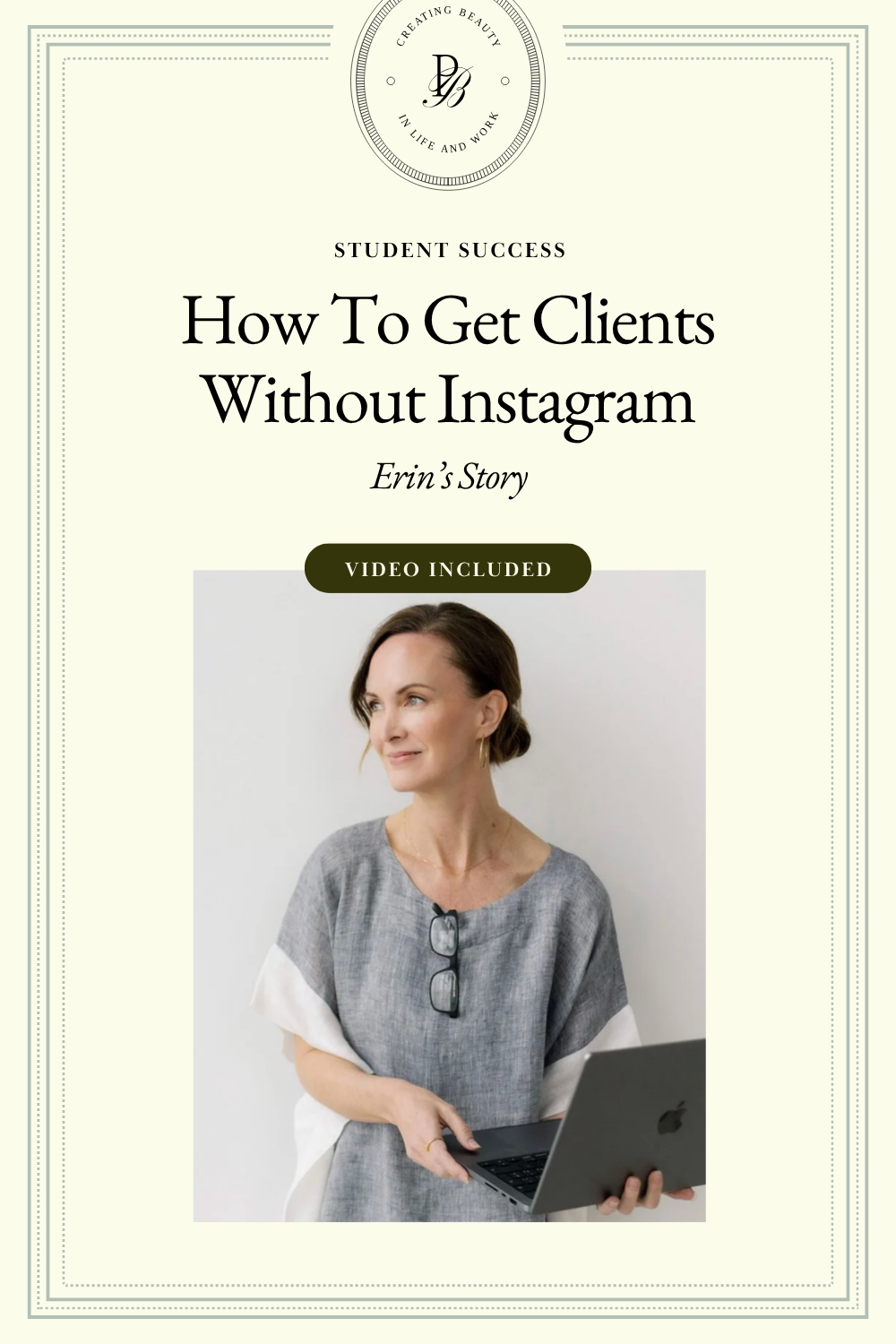
If you're tired of the constant posting treadmill and wondering whether there's a quieter, more sustainable way to build a web design business — Erin's story is the one you need to hear. She's been in the design industry for over 15 years, runs a calm and steady business booking $5,000 websites, has started adding template income on the side, and does essentially zero social media. Her two main client sources? Referrals and SEO. And she does it all from Italy.
I sat down with Erin to talk through her journey, her marketing approach, her thoughts on AI and industry saturation, and what it actually looks like to build a business that fits your life rather than the other way around. Watch the full interview below, or keep reading for the highlights.
Watch the full interview with Erin here — she shares the real story, in her own words.
From art history to Dreamweaver to Squarespace — the non-linear path
Erin's background is in traditional art and art history. When she graduated, web design wasn't on her radar at all — she started with logo work and print materials, mostly through family and friend referrals, while working for a couple of different companies. The freelance projects on the side slowly planted a seed: maybe I can actually do this on my own.
She eventually left her 9-to-5 — scary, she says, but also liberating. About six months in, a logo client asked if she could also build a website. She said yes without hesitating, despite having no idea how. She taught herself through tutorials, built the site in Adobe Dreamweaver, didn't charge nearly enough — and her client was happy. That was the foot in the door.
WordPress followed. Then a long search for something better to hand off to clients — small business owners who needed to be able to update their own sites without calling her every time a price changed. That search ended with Squarespace. And when the learning curve felt steeper than expected, she went looking for help — which is how she found her way here.
The path from art history to logo design to website design wasn't a straight line. But it was a logical one, and it absolutely was possible. That's worth saying plainly, because a lot of people who come to web design from creative or non-technical backgrounds assume the journey should have been more direct. It rarely is.
Is the industry oversaturated? Erin's answer after 15+ years
This is one of the questions I get most often, so I was especially glad to get Erin's take — someone who has actually watched the industry evolve over more than a decade and a half.
Her answer: no. Not even close.
Small businesses are starting every single day. Many of them need a brand new website. Many of the ones that already have a site have a terrible one. The demand isn't shrinking — and the pool of clients isn't one-size-fits-all, either. What you bring to the table as a designer — your eye, your taste, your way of working with people — is genuinely different from what someone else brings. Erin put it this way: it would be like asking whether there are too many photographers in the world. There aren't, because every photographer's vision is different.
And if you have a particular edge — a strong design sensibility, deep knowledge of a specific industry, a way of making non-technical clients feel at ease — that's what sets you apart. You don't need to compete with everyone. You just need to be the right fit for your people.
Taking the course after already running a business for years
Here's something I find really interesting about Erin's story: she wasn't a beginner when she enrolled in Square Secrets Business. She had been running a design business for years. So what made her sign up?
She was switching to a new platform and wanted to get up to speed quickly. While Googling how to learn Squarespace, she found this site — and what struck her wasn't just the content, but the sheer volume of free help on offer. It built trust. If the free stuff was that good, the paid course was going to be worth it.
She describes it as an investment — in herself, and in her ability to serve her clients at the level she wanted to. Not an expense. An investment. And the return came fast.
She made back the cost of the course in half a project. Literally. She took on her first Squarespace client after completing the course, charged what she needed to charge, and the project fee was roughly double the course price. That was just the starting point — from there, it kept going up.
Pricing: from $1,500 to just under $5,000
When Erin first started working on the Squarespace platform, she was charging around $1,500 to $2,000 per project, depending on scope. Her average client investment now is just under $5,000 — a full website package for a solopreneur or small business, including one-on-one time, post-launch tutorials, and guidance on how to actually use and maintain the site going forward.
Those prices didn't creep up slowly over many years. They went up quickly. Because with each project came more experience, more confidence, and a clearer sense of what the work was actually worth. Taking on a couple of projects a month at that rate — she puts it simply: you can do the math. It's a nice way to work.
Adding template income: what she learned
Alongside her client work, Erin has started selling website templates — her way of building what she calls mildly passive income. Not 100% hands-off, but close enough.
Once she felt genuinely confident on the platform, it was a natural next step. She already loved the design work. Seeing others selling templates made her realise she could do the same, and add a revenue stream that didn't require trading more hours for more money.
Her advice to anyone thinking about it: just jump in. There is some tech involved that's different from client work — enough that a course is worth it to avoid the subtle pitfalls. There are different platforms to sell on, and it can feel overwhelming at first. But the payoff, including seeing someone look at your template and think yes, that's me, I can make that mine — is genuinely rewarding.
The marketing plan: referrals + SEO, no social media required
Erin has an Instagram account. She's not really using it. And her business is fully booked.
Her two primary client sources are referrals from past clients and organic search — people finding her through her blog. She's been fortunate with referrals from the beginning, but she never wanted to rely on that alone. The blog came out of wanting to build her email list, get some organic eyes on her site, and provide genuinely useful content to her audience. She took Audience Academy to sharpen her approach, uses a content calendar to stay on track, and she's seen real organic activity as a result.
What I love about how she talks about social media is the clarity. She tried it. She didn't see much return. It was a time drain. So she made a decision: her time is better invested in her website, her blog, and SEO — things that compound over time and live on her own platform rather than someone else's algorithm. She might post on Instagram occasionally, but it's not a strategy. It's occasional.
This is one of those things I think is so valuable for other designers to see: you can absolutely build a successful, fully-booked web design business without social media. Erin is proof. The key is picking one or two marketing methods you can actually commit to and do well — not attempting all of them and burning out on every single one.
"I don't really try to fear anything" — on blogging, competition, and ranking
One of the things that holds people back from starting a blog is the belief that everything's already been written — that they can't possibly rank against someone who's been publishing for years. I asked Erin about this directly, knowing she'd started her blog more recently than many.
Her answer was quietly wise. She doesn't spend energy worrying about where she ranks relative to anyone else. She writes in her own voice, about things she's actually run up against in her own business — problems she hit, solutions she found, things she figured out that someone else might benefit from knowing. If that content ranks, great. If it brings in one ideal client who really needed that specific post, even better.
Trying to out-compete established sites for top rankings isn't a healthy obsession to have. Providing genuinely helpful content in your own voice, consistently — that's something you can actually sustain. And over time, people find you.
On AI and whether web designers will still be needed
Erin's been around long enough to have watched multiple waves of technology change the industry. Her view on AI is calm and grounded: she's not worried about job security.
And here's why, which I think is the most important thing to understand about this whole question: look at who is actually hiring web designers. Erin's typical client is a solopreneur or a small business with a few employees who are not tech-savvy, who are already intimidated by the idea of touching their own website, and who are paying just under $5,000 for a site because they genuinely cannot — or will not — do it themselves.
Easy website building tools have existed for years. They've existed the entire time Erin has been running her business. And those clients have still been showing up, still been paying professional rates, still been grateful for the hand-holding and the expertise and the confidence that comes with handing the project to someone who actually knows what they're doing. AI is another tool. It doesn't change the fundamental reality that the clients who hire designers aren't the ones who were ever going to DIY it anyway.
Life in Italy, clients in the US
Erin's husband is Italian, and they've been based in Italy for a long time — though with some back and forth to the US over the years. She describes it with the kind of warmth that only comes from someone who genuinely loves where they live: walkable streets, morning cappuccinos, afternoon Aperol spritzes with friends.
Her clients are mostly in the US — a natural result of years of referrals built up there, and a comfort with the small businesses in the places she knows and loves. But the beauty of web design, as she puts it, is that you can take it wherever you go. She's doing exactly that, building sites for US clients from her Italian home, on her own schedule, in a city she loves.
That's the version of the business she's built. And she built it without a niche, without social media, without a particularly aggressive marketing strategy — just consistent quality work, clients who talk to other clients, a blog that brings people to her organically, and a clear sense of what she wants her working life to actually feel like.
If Erin's story has you wondering whether this could be your path too — the answer is probably yes. The journey doesn't have to be a straight line. It just has to be yours.