How Jenna Went from $400 to $6,000 Web Design Projects Using Upwork
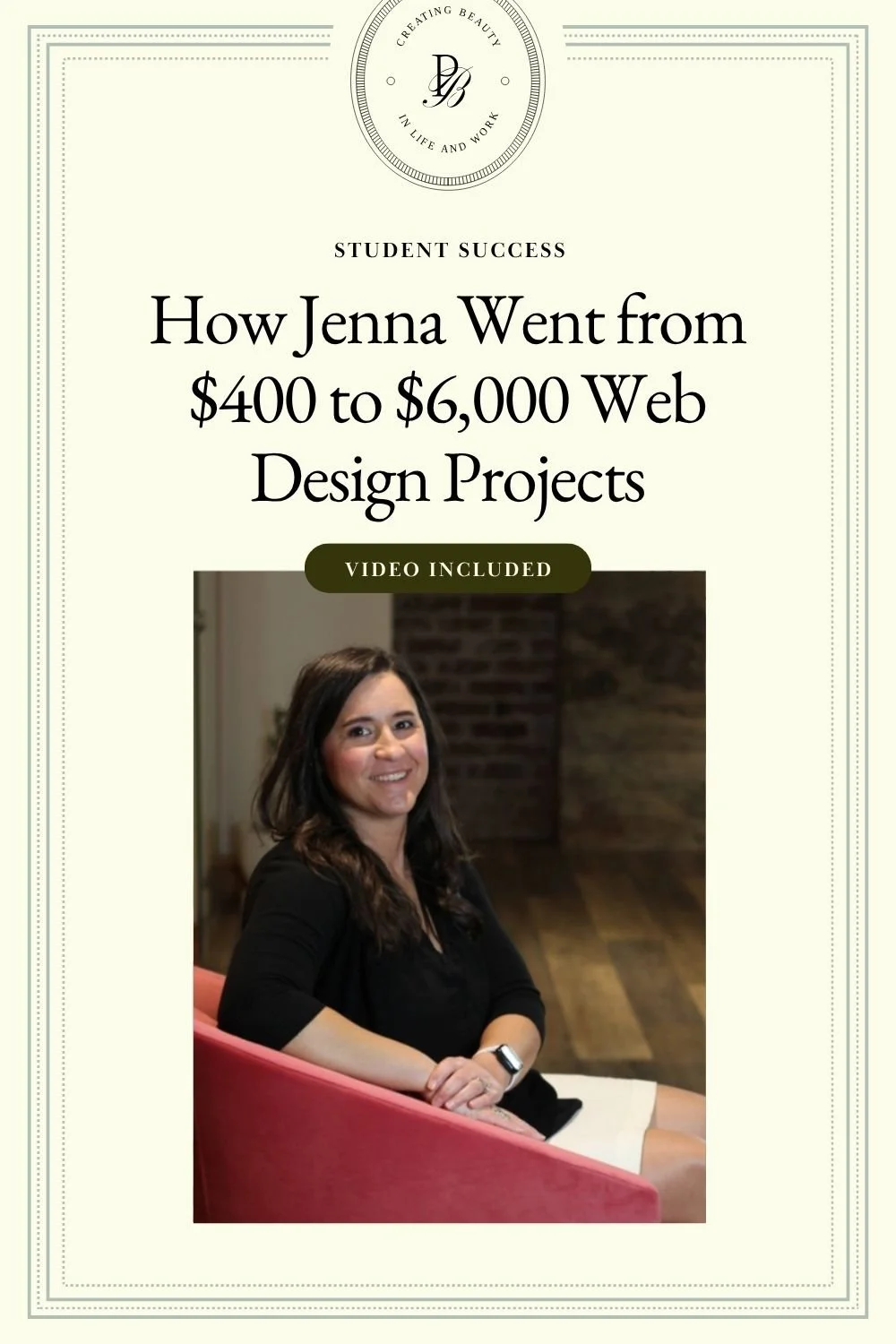
If you've ever sent a proposal into the void and wondered whether anyone was actually reading it — this one's for you. Jenna is a past Square Secrets Business student who went from charging $400 for her very first website to landing a $6,000-plus project, and she has a lot to say about what actually made the difference. We're talking Loom videos, Upwork, pricing your way up project by project, and what it really means to show up as a human being rather than another generic proposal in a pile.
There are also some genuinely beautiful business-and-life details woven through this one — Jenna runs her web design business alongside her husband in the Pacific Northwest, balances it with part-time bookkeeping work she loves, and has built the whole thing from a place of real necessity after a difficult few years. I think you'll find her honest, warm, and full of the kind of practical wisdom that only comes from having actually done the thing.
Prefer to watch? Catch the full interview below, or keep reading.
From eBay reseller to web designer — the backstory
Before any of this, Jenna and her husband ran their own online reselling business — starting on eBay, then Amazon, buying used products, cleaning them up, and flipping them for more. They eventually started importing their own electronics (her husband's niche), doing their own graphics, and building out a proper operation.
Then the pandemic hit. Her father-in-law passed away unexpectedly. They both got seriously ill. The business tanked with the economy. And Jenna — who has her own health challenges that make working from home not just convenient but genuinely necessary — found herself and her husband asking a question a lot of people have had to face: What do we do now?
They tried Upwork with some graphic work. It wasn't paying the bills. They were sinking further into debt. Jenna was exploring real estate as a possibility, even had lunch with her cousin's wife who was in the industry, and left that lunch still not feeling it. Less than a month later, she saw Square Secrets Business.
"I walked into my husband's office and said, 'I know we don't have the money, but I feel like this is going to be worth it.'"
He said: if you think that's what's best. She bought it that night.
The $400 first website — and why the course changed everything
Here's something that surprised even Jenna: she had actually completed her first website before taking the course. A friend of a friend with an established business needed a better site — Jenna built it on Wix and charged $400. Then that same client's mother needed a website. Jenna built that one on Squarespace.
"I hated it," she says, laughing. "Like, I hated Squarespace. I did not want to do this again."
And then she took the course — and the whole thing clicked. Not just the platform mechanics, but something more fundamental. What Square Secrets Business gave Jenna most was confidence. The belief that she could actually learn new things and figure things out. Growing up, she says, it had been easy to start something, hit difficulty, and give up. The course quietly dismantled that pattern.
"It was like: I know I have my ducks in a row. I'm not missing anything. I can do this."
She now does Squarespace exclusively — no Wix, nothing else. Her reasoning is smart and worth paying attention to: when you work across multiple platforms, you're constantly relearning. You do a Wix site at the start of the year and then don't do another until the end of the year, and by then things have changed. When you commit to one platform and go deep, you build genuine expertise that compounds with every single project.
From $400 to $2,100 to $6,000 — the pricing progression
After taking the course, Jenna decided to test a higher price with the first client she found through Upwork — someone she'd never met, no warm connection, no favours involved. She charged $2,100.
"It worked. So the next one, I raised it a bit more. And then a bit more."
Her approach to pricing isn't a rigid formula — raise by X% every quarter, or up by a set amount after every project. It's more intuitive than that, and scope-dependent. A smaller, more minimal build gets priced accordingly. A larger, more complex project justifies more. Over time, as her confidence grew and her process got tighter, so did the numbers.
The most recent project she and her husband completed — which also included a product video her husband produced — came in at over $6,000. That's not the ceiling. It's just where they are right now.
Looking back at the numbers in preparation for our conversation, Jenna could see the arc clearly: she started in August 2022, charging $400 for her first site. In 2023 (the year she took the course, around April), she more than doubled her profits. Last year — 2024 — was almost two-and-a-half times the year before that.
From "I know we don't have the money for this course" to two-and-a-half times year-over-year growth. I love that.
Upwork — and the thing that actually changed everything
Jenna finds most of her clients on Upwork, which isn't a strategy I cover in the original Square Secrets Business course — though we've since added it into the marketing interview section, so it's in there now. For a while, she was putting pressure on herself to blog, to do all the other things. Then it clicked: Upwork is her marketing. That's where she's putting her energy, for now — with an eye to diversifying eventually, since you don't want your whole pipeline dependent on a platform you don't control.
But here's what she said when I asked what changed on Upwork — what made it actually start working:
"I didn't start seeing results until I went massively outside of my comfort zone."
That means video. Specifically, Loom videos.
When Jenna sees a project on Upwork she wants to pitch for, she records a short personalised Loom — and if the potential client already has a website (or something started), she asks if she can look at it first and then gives them honest, useful feedback in the video itself. She's not reading from a script. Every video is different. It takes real time — she estimates around three hours from first spotting a project to landing the client, including all the admin. But when you're going for $4,000 or $6,000 projects, that three-hour investment makes complete sense.
The Loom video does two things at once: it proves you're a real human, and it gives value before anyone's paid a penny. Jenna's noticed that even people who don't end up hiring her often comment on the video — they're used to receiving completely generic, copy-paste proposals, and a personalised video stands out immediately.
A few other Upwork specifics worth noting:
→ Timing matters, but not absolutely. She tries to respond to invitations within 24 hours, and applying within a couple of hours of a project posting does make a difference. But she also deliberately looks for projects that have been up for a few days with no hire yet — these people have plenty of proposals but haven't found the right fit, and she'll even acknowledge that in her video: "I saw you posted this five days ago. If you've found someone, great. If you haven't…"
→ Her portfolio page on Upwork is something she'd honestly like to improve — she freely admits it's still not where it could be, which is a good reminder that even people landing $6,000 projects have things they're still working on.
→ She keeps it simple. When she has a project on, she's not hunting for the next one. She looks when she needs to, and she doesn't obsess over conversion rates. ("I don't pay attention to that," she told me cheerfully. "We just keep things simple.")
On giving website feedback without being brutal about it
I had to ask about this, because it's genuinely tricky: how do you record a Loom critiquing someone's existing website — often one they're quite attached to — without either being uselessly vague or accidentally making them feel terrible?
Jenna's approach is straightforward. She starts by finding what's genuinely good and saying so. Not hollow flattery — actual things. Then she moves into the problem areas clearly and specifically: here's what's not working, here's how we could fix it, and here's what that would do for your business. She'll sometimes say directly, "I don't need to be harsh, but these are the problem points" — which, honestly, most people appreciate more than diplomatic tip-toeing that tells them nothing. Then she invites them onto a Zoom call to talk it through properly.
The websites she secretly loves getting are the really bad ones. Because those are the ones where the value she can bring is completely obvious — and that makes the whole conversation easier.
Running a web design business with your spouse
Jenna and her husband work together on every project — which is unusual, and which people are naturally curious about. The short version of whether it works: yes, but she thinks the reason it works is that they have very different skill sets and don't overlap much.
She handles the design side — the visual work, making things look beautiful and cohesive. He handles copywriting, quality control, and (increasingly) video production — it was a product video he shot and edited that pushed their most recent project past $6,000. When they're working on a project together, there are often stretches where he's heads-down on something that doesn't need her yet, which means she can be across at her bookkeeping work in the meantime.
Different skill sets also means they're not both pulling in different directions on the same decision. When two people think differently and are doing different things, the friction is low and the output is complementary. If they were both doing design work and expressing different opinions about every layout choice — that would be a different conversation.
Balancing web design with the rest of life — including a part-time bookkeeping job
Jenna also works part-time as a bookkeeper. She earns less per hour than she does designing websites — she knows that — but she loves the work and loves the people she works with, and it's flexible enough to fit around project timelines.
The way she makes it all work is through process and organisation, built deliberately over time. Every project has taught her something: a question she should have asked earlier, an area where she could be clearer with the client, a handoff that could go more smoothly. She implements those lessons each time, and the process keeps getting tighter. Her recent clients have specifically noted how smooth and clear the experience feels — which she credits to those incremental improvements compounding over two-plus years.
Web design also has a natural rhythm that accommodates other commitments. You design something, then you wait for feedback. That gap isn't dead time — it's a window to do other work, run other errands, actually have a life. Jenna and her husband try to keep things deliberately simple: they do volunteer work teaching people about the Bible, which is genuinely important to them, and that requires time and presence. The business exists to support their lives, not the other way around.
"Sometimes you feel the pressure to work more, more, more," Jenna says. "But that's not the most important thing in our life. So we try to keep readjusting as we go."
"If you think it's oversaturated, that's probably what you'll find"
I asked Jenna the question I get all the time: is it too late? Is it oversaturated? Are there still projects out there?
She was honest about the fact that it was one of her own worries when she started. And then she said something I thought was quietly sharp:
"If you think it's going to be oversaturated and there's not going to be work, that's probably what you're going to find."
Her actual experience is that there's plenty of work. People who worry that specialising in one platform limits them, or that niching down to certain clients will shrink their opportunities — that's not what she's seen. There are people starting new businesses every day who need websites. There are established businesses with terrible sites that don't match the quality of what they do. There are people who pick up web design and then don't stick with it, which is just the natural churn of any field. The opportunities are there. The question is whether you go looking for them.
On the mindset of seeing things through
One of the things I kept coming back to in this conversation was Jenna's arc with confidence. She grew up in a way that made it easy to start things and then give up when they got hard — she says that directly, without drama about it. Getting to a point where giving up wasn't an option anymore, because the circumstances were too pressing, and then discovering that she actually could figure it out — that changed something. Not just for web design. For everything.
"Once you're able to see what you're capable of, it helps you do that in other areas of life."
I find this is one of the things that surprises people most about learning web design as a business skill — it's not really just about websites. It's about proving to yourself that you can pick up something genuinely hard and run with it. Everything that comes after that feels a bit more possible.
On being on the fence about taking the course, Jenna put it simply: "You could find plenty of stuff on YouTube, but do you have the time? The course gave me a good jumping-off point and I was able to just go. The confidence alone was worth it — and that's before I even get to the revenue I wouldn't otherwise have made."
Jenna's story is one of those reminders that the starting point doesn't have to be glamorous — it can be messy, financially tight, personally hard — and the business can still grow into something genuinely good. The specifics of how she got here matter: the Loom videos, the Upwork approach, the deliberate pricing progression, the process she's built project by project. Those aren't accidents. They're the result of someone who decided she was going to figure it out — and did.
- The #1 Way to Get Web Design Referrals (+ Upwork Tips You'll Wish You Tried Sooner)
- 3 Web Designer Business Rules I Break
- How Mariana Quickly Reached Her First $9K Month as a Web Designer
- A Unique Web Design Process That Works, Even If You Have a 9–5 Job
- How Ayesha Used Instagram to Hit Her First $10K Month as a Web Designer