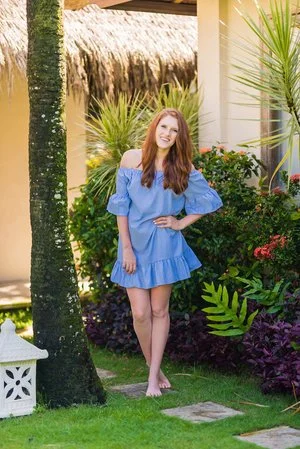
From a $500 Quote That Didn't Book to $6,500 Websites — Samara's Story

The first project Samara Bortz ever quoted was $500. The client didn't book.
That's not usually where these stories start, but it's exactly where hers did — and it's a big part of why I wanted to share it. Samara is a Square Secrets and Square Secrets Business student who signed up right at the start of the pandemic, taught herself design with zero formal training, and now runs a full website and branding business — pricing full packages around $9,000, landing most of her clients through Instagram, and building out a second, more scalable income stream on the side. I sat down with her to talk about how she actually got there, one price raise and one platform at a time.
Prefer to watch? Catch the full conversation below, or keep reading.
A pandemic pivot, not a five-year plan
Samara signed up for both courses at what she calls "the very start of the pandemic" — a huge time of change, and, as it turned out, a really good one. She'd been doing design work for a while, but informally: for friends, for another business she was running, for a couple of nonprofits. She loved it, and she wanted something she could do from home during daytime hours, because her other job was all evening work and had just been completely shut down.
What actually pulled her in wasn't the design side — it was the business side. She told me what motivated her to sign up was being able to take something that was so informal at the time and turn it into consistent income, not just get better at the design skills themselves.
No design degree. Just Nexopia and MySpace.
Here's the thing that I think should give a lot of people permission: Samara has no formal design education. No design degree. All self-taught. Her actual design origin story is a '90s-kid one — messing around on Nexopia and MySpace as a teenager, building profiles with basic CSS, customizing Squarespace templates for another business she was running and a couple of friends. That was it. That was the whole résumé.
I don't need to have a computer science degree to build great websites, and neither do you — but Samara's story is the concrete version of that, not just the reassuring version.
Trades first, paid client four to five months later
Samara didn't binge the courses — she worked through them at her own pace, which took about a month. When she finished, she didn't go straight to paid work. She arranged a couple of trades first: one with a photographer, in exchange for brand photos, and one for a fitness studio she was working out at, in exchange for free classes.
She finished the course in August. Her first paid client came in December or January — four to five months later. That's a real timeline, not a highlight-reel one, and it's worth sitting with if you're in the "why hasn't this happened yet" stage.
The $500 quote — and the slow climb from there
I asked Samara what she was charging when she started, versus now. Now, a website-only project starts around $6,500. A full package with branding included runs around $9,000.
But that first quote — the very first one — was $500. And the client didn't book.
She started out charging just under $2,000 for what was roughly a five-page website, and raised it gradually from there as she added more into each project and gained experience — eventually gaining the skills to offer full brand design, copywriting support, launch strategy, and brand strategy alongside the build itself. She also adjusted her timelines as she went: shorter turnarounds at the start, more time with each client now.
"I definitely had to build up confidence to where I am now," is how she put it. Not a formula. Not a script. Confidence, built project by project.
The Instagram account she swore she'd never make
This is my favourite turn in the whole conversation. When Samara took the course — and even before — she was dead set against making a business Instagram account. Her words: "I'm not going to make an Instagram account. This is too much. I don't need to be on Instagram more."
And then she made one anyway, and it became the best source of clients she's had since. Instagram is where she's most active, where she's invested the most marketing energy, and where most of her organic leads come from today — alongside referrals, and some traffic through Google search and blogging.
What changed her mind wasn't a marketing tactic. It was realising it's such a visual platform that refusing to share her work on it was, in her own words, "stupid."
Three platforms, three different reasons
Samara doesn't just build in Squarespace — she also works in Show It and Shopify, and she picked each one up for a specific, practical reason rather than to pad her skillset.
Show It, for the design flexibility
Show It came first, about a year after she took the course. At the time, she was running into design limitations in Squarespace — though she was quick to note those are now largely gone thanks to Fluid Engine. She also wanted to be able to offer two platform options to clients who specifically wanted Show It.
Shopify, for two reasons
Shopify came next, for two reasons: some clients needed proper e-commerce integration built into their site, and Samara had her eye on eventually working with larger brands or brands with a deeper product suite — something more e-commerce-intensive than Squarespace, which she says works great for a small store but not as well for a brand with hundreds of products.
As she put it: each platform works well for different clients, so it's up to the option that fits.
Branding, websites, and a coaching container most designers skip
Samara's core offer is websites and branding — but she structures her projects a little differently from most designers. Every project starts with a mini coaching container, or brand strategy coaching container, before the design work begins.
That's not a coincidence. Alongside her design business, Samara also does one-to-one mentorship for other creatives — designers, and women who are creative entrepreneurs more broadly. The coaching instinct shows up inside her client projects too, not just as a separate service.
Who she actually works with
Samara didn't niche into a single industry — she's not exclusively working with photographers, or exclusively with any one type of business. If anything, her niche is stage of business: clients who are at least a couple of years in, done with the DIY route, and ready to outsource. Within that, she works across a real range of industries — hairdressers, painters, photographers, jewellers, even holistic nutritionists who consider themselves creative souls at heart.
From client services to something more scalable
As Samara's client roster grew, two things happened at once. She started booking out further in advance. And clients kept arriving at the same moment — right as they were launching their new website — realising they also needed to get serious about email marketing, and feeling completely overwhelmed by the tech.
That overlap is what sparked the idea: a more scalable product she could hand to clients signing on for a website package, so she wasn't doing all the tech setup herself for every single one — and something that could also serve people in her audience who weren't coming to her for one-to-one work at all.
The result is a course, launched for the first time this past spring and set to relaunch again later this year, focused on email marketing for creatives using Flodesk — covering the tech side as well as strategy for growing an email list and creating an impactful freebie. Samara is quick to laugh at the word "passive" — launching a course is a huge amount of work, she says — but the concept is right: a digital product sitting alongside the one-to-one services, not replacing them.
On being an introvert and still landing every client
A lot of people assume you have to be loud and extroverted to market yourself or run sales calls successfully. Samara doesn't buy it — and she doesn't think you have to overcorrect into a "businessy persona" to prove you're serious, either.
Her approach to consult calls is built around structure, not personality: knowing the format the call will take, treating it more as a conversation than a pitch, and asking permission all the way through — is it okay if I ask about your business now, is it okay if I share about mine. That framework, she says, takes the pressure off having to perform a version of herself she isn't.
Her marketing follows the same logic. Rather than forcing herself to show up daily on camera, she pays attention to her own energy and batches content when she's feeling more outgoing — recording reels or pre-writing stories in advance, then posting them later. A lot of what she shares is Instagram stories that are just photos with text over them, because writing is a more comfortable medium for her than speaking to a camera. And she takes weekends off Instagram entirely.
The point isn't the specific tactic — it's giving yourself permission to market in a way that actually fits how you're wired, instead of copying whichever version of "showing up" looks loudest online.
Her advice, if you're on the fence
I asked Samara what she'd say to someone who's watching, self-taught or not, wondering if they could do what she's done. Two things, tied together: go for it, and invest in support earlier than you think you're ready to.
Don't let the fear of not being qualified stop you before you start — you'll learn as you go. And investing in good quality help early, whether that's a course or one-to-one coaching, is what actually moves you from "just starting" to the business you're envisioning, rather than staying stuck circling the idea of it.
On what the courses gave her specifically, she was clear it wasn't just the design skills and the Squarespace tips inside Square Secrets. It was having a roadmap to actually start the business — support with marketing, exposure to different marketing avenues, and learning systems like Honeybook that have saved her enormous amounts of time she had no idea about beforehand.
If Samara's story sounds like the version of this you've been putting off starting — the $500 quote that didn't book, the account you swore you'd never make, the price you're scared to ask for — none of that disqualifies you. It's just the beginning of the story, not the end of it.
And if you want to figure out which client-finding approach actually fits you — rather than copying Samara's Instagram-first strategy if that's not your instinct — take the Client Finding Method Quiz to find the one that matches your personality.
- How Niching Down as a Web Designer Took Stacy From $500 to $2,400 Projects
- From $500 to $5,000 Projects: How Megan Built a Full-Time Web Design Business
- How Jenna Went from $400 to $6,000 Web Design Projects Using Upwork
- $150/Hour as a Web Designer & 5-Hour Workweeks — Helen's Story
- What If You Didn't Have to Post on Instagram to Get Clients? — Erin's Story